

Step-by-Step Guide Using Ignite UI for Angular Schematics
The Ignite UI for Angular Schematics step-by-step mode is an interactive wizard built into the @igniteui/angular-schematics collection. It guides you through project bootstrapping, template selection, and theming, then lets you add component views before finishing. The wizard can be activated for both new project creation and for adding views to an existing project previously created with the Ignite UI Angular Schematics.
The step-by-step mode does not support non-interactive or scripted use - for that, use the direct ng new and ng g commands with explicit arguments. The wizard relies on Inquirer.js; see supported terminals for compatibility.
To activate the guided wizard, run:
ng new --collection="@igniteui/angular-schematics"
Create a New Project
The wizard guides you through the following configuration steps before scaffolding the project. When Side Navigation or Side Navigation Mini is selected as the template, an additional authentication step appears.
Step 1: Choose a bootstrapping type
The first prompt asks whether to bootstrap the application using standalone components or NgModules.

Standalone components are the Angular 17+ default and are recommended for new projects. Choose NgModules only if you are integrating with an existing NgModule-based codebase.
Step 2: Enter a project name
Enter a name for the new application. The project is created in a directory with the same name.

Step 3: Choose a project template
Navigate the available project templates using the arrow keys and press ENTER to confirm. Three base templates are available:
- empty - a project structure with routing and a home page, no pre-built navigation
- side-nav - a project structure with a pre-built side navigation drawer
- side-nav-mini - a project structure with a pre-built compact side navigation drawer

If you select side-nav or side-nav-mini, the wizard will prompt you with an additional step asking whether to add an authentication module to the project. Answering yes generates the corresponding auth variant (side-nav-auth or side-nav-mini-auth). If you select empty, the authentication prompt is skipped.

Step 4: Choose a theme
Two theme options are available:
- default - includes a pre-compiled CSS file (
igniteui-angular.css) with the default Ignite UI for Angular Material-based theme inangular.json - custom - generates a color palette and theme configuration using the Theming API in
app/styles.scss, ready for customization

After completing the above steps, the wizard generates the project structure, then prompts you to configure AI coding assistants. Once AI configuration is complete, a Git repository is initialized and the initial state is committed. The wizard then asks whether to finish or continue by adding a component view.

Add Component Views
The Ignite UI for Angular Schematics collection provides individual component templates and more elaborate scenario templates. This mode is available both as a continuation of project creation and as a standalone operation in an existing project.
To activate the component wizard in an existing project, run the component schematic (alias: c):
ng g @igniteui/angular-schematics:componentThe wizard displays the available component templates, grouped by category. Navigate with the arrow keys and press ENTER to select.

Some templates - such as the Custom Grid - expose a list of optional features. Use the SPACE key to toggle individual options before confirming with ENTER.
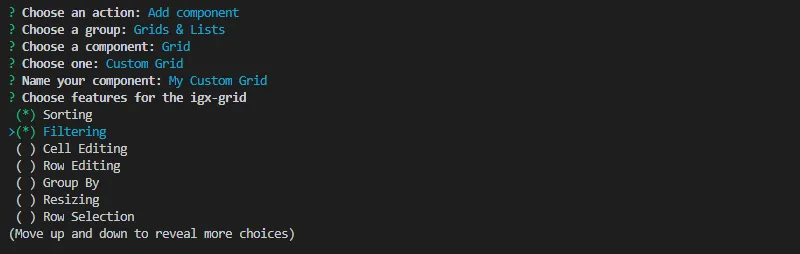
Scenario templates are also available and provide more complete application views that combine multiple components. Select “Scenarios” in the category list to browse them.

After adding a template, the wizard asks whether to add more views or complete the process. On completion, any remaining package dependencies are installed and the application is served and opened in your default browser.
To add more Ignite UI for Angular views to a project later without the wizard, use the direct schematic command:
ng g @igniteui/angular-schematics:c [template] [name]AI Assistant Integration
After choosing your bootstrapping type, project name, template, and theme, the wizard prompts you to configure AI coding assistant integration. This step runs the same logic as ng generate @igniteui/angular-schematics:ai-config but is embedded in the project creation flow.
Choose coding assistants
You will be prompted to select which coding assistants to configure MCP servers for. Use the SPACE key to toggle selections and ENTER to confirm:

- Generic (Claude Code, VS Code, and others) - writes
.mcp.json - VS Code (GitHub Copilot) - writes
.vscode/mcp.json - Cursor - writes
.cursor/mcp.json - Gemini - writes
.gemini/settings.json - JetBrains Junie - writes
.junie/mcp/mcp.json - None - skips MCP configuration
The default selection is Generic. Selecting None skips MCP server configuration entirely.
Choose AI agents
Next, you will be prompted to select which AI agents to configure skill files and instructions for:

- Generic -
.agents/skills/andAGENTS.md - Claude -
.claude/skills/and.claude/CLAUDE.md - Copilot -
.github/skills/and.github/copilot-instructions.md - Cursor -
.cursor/skills/and.cursor/rules/cursor.mdc - Codex -
.codex/skills/and.codex/instructions.md - Windsurf -
.windsurf/skills/and.windsurf/rules/guidelines.md - Gemini -
.gemini/skills/and.gemini/GEMINI.md - Junie -
.junie/skills/and.junie/guidelines.md - None - skips skill files and instructions
The default selections are Generic and Claude. Selecting None skips agent configuration entirely.
When run via the Angular schematic, an additional angular-cli MCP server entry is included automatically alongside the Ignite UI servers.
To skip AI configuration prompts entirely during non-interactive project creation, pass --assistants none --agents none to ng new. To re-run AI configuration later, use ng generate @igniteui/angular-schematics:ai-config from the project root.
For MCP client configuration and a full description of available tools, see Ignite UI CLI MCP.